
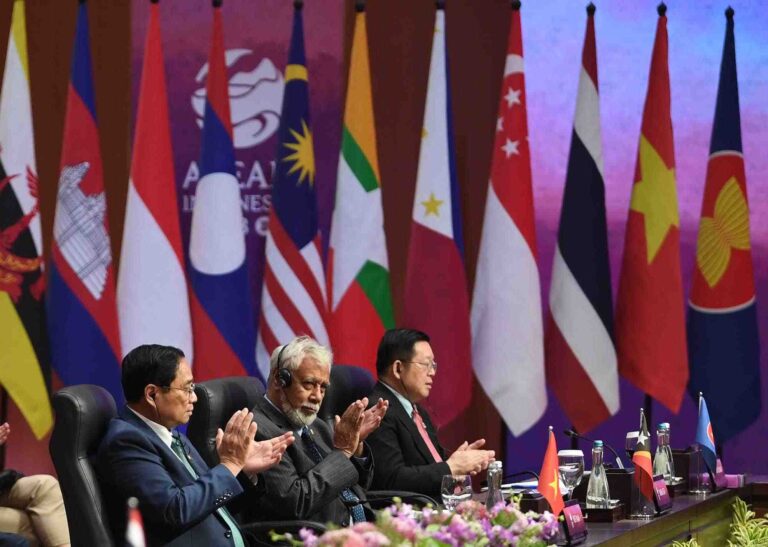
When Timor-Leste formally became the eleventh member of ASEAN in October 2025, the moment was widely described as historic. After fourteen years of waiting, Southeast Asia’s youngest nation finally crossed what its leaders had often portrayed as a near-mythical threshold. The symbolism of accession was powerful: reconciliation with Indonesia, long-sought regional acceptance, and entry into a bloc representing more than 680 million people and one of the world’s largest regional economies. Yet the significance of Timor-Leste’s membership extends well beyond symbolism. Its accession also carries a tangible geopolitical dimension. By admitting its easternmost member, ASEAN extends its geographic reach and reinforces its relevance within the Indo-Pacific. Positioned between Southeast Asia and the Pacific, Timor-Leste adds strategic and diplomatic diversity to the bloc. Enlargement itself is also a sign of institutional vitality: rather than stagnating as a closed grouping, ASEAN continues to evolve, expand, and incorporate new political and economic realities into its regional framework.
At the same time, concerns about China’s growing economic presence in the country have been a prominent feature of regional debates, underscoring how broader patterns of regional competition shape Timor-Leste’s accession. The key issue is not simply whether Dili has close relations with Beijing – many ASEAN members do – but how Timor-Leste’s ties to China may play out inside a bloc already struggling to maintain coherence on sensitive external issues. In this sense, Timor-Leste’s accession unfolds within ASEAN’s long-standing strategy of balancing relations between major powers, including China, the United States and the EU. Timor-Leste has cultivated a warm relationship with China, marked by extensive Chinese involvement in infrastructure and development projects, which has led some observers to question whether Dili might join ASEAN as an additional pro-China voice. This reflects a deeper concern about ASEAN’s vulnerability to fragmentation. ASEAN has already been exposed to internal divisions, as members adopt sharply different alignments toward China and the United States, especially on contested regional security issues. Yet China’s regional presence is not only a source of concern but also part of what makes ASEAN strategically vital.
Taken together, these symbolic and geopolitical considerations help explain why Timor-Leste’s entry into ASEAN has attracted such attention. Its membership raises more fundamental questions about integration, persistent development gaps, and the institutional capacity of ASEAN itself. Thus, Timor-Leste’s admission not only exposes long-standing tensions between ASEAN’s normative aspirations and the practical limits of its integration model, but also offers opportunities to both sides.
ASEAN Membership as a Core Timorese State-Building Project
Since regaining independence from Indonesia in 2002, Timor-Leste has treated ASEAN membership as a cornerstone of its foreign policy. The objective has attracted rare cross-party consensus in Dili, uniting political leaders around the shared aim of embedding the young state in Southeast Asia’s main regional framework. The Timor-Leste journey to ASEAN was complex. It obtained observer status that same year, joined the ASEAN Regional Forum in 2005, signed the Treaty of Amity and Cooperation in 2007, and formally applied for full membership in 2011. For Dili, ASEAN has long represented a means to secure sovereignty, reduce external vulnerability, and anchor national development within a multilateral setting..
Timor-Leste’s prioritisation of ASEAN also marked a deliberate choice over alternative alignments such as the Pacific Islands Forum. Although early independence leaders often voiced cultural affinities with the Pacific, Dili’s ultimate orientation toward Southeast Asia signals both a strategic and symbolic shift. ASEAN’s eventual acceptance serves as a late but meaningful recognition of Timor-Leste’s Southeast Asian identity. Yet, the road to membership has been protracted. Some ASEAN members, like Singapore, for instance, questioned Timor’s accession due to resource limitations, delaying the process despite its consistent engagement. Moreover, Myanmar opposed the path due to Timor´s engagement with the pro-democracy movement in Myanmar (NUG). Only in 2022 did ASEAN agree “in principle” to admit Timor-Leste, subject to meeting various milestones – a process President Ramos-Horta famously compared to “fulfilling all the criteria to enter heaven.”
ASEAN membership carries tangible economic promise. Access to a $3.8 trillion market of 680 million people could attract investment, generate jobs, and reduce heavy reliance on oil and gas revenues. However, with about two-thirds of households engaged in subsistence farming and a poverty rate near 40%, the transition to ASEAN’s open trade regime must be gradual. Political economist and a former Minister of the Presidency of the Council of Ministers of Timor-Leste, Fidelis Magalhães, has argued that phased integration, akin to Laos, Vietnam, and Myanmar’s approach, would allow time to strengthen domestic production and export capacity. Ultimately, ASEAN membership signifies more than economic opportunity. It represents acceptance, recognition, and inclusion, a final affirmation of Timor-Leste’s rightful place within Southeast Asia’s political community after decades of marginalisation.
ASEAN’s Reluctance and the Question of Readiness
While Timor-Leste’s commitment to ASEAN was consistent, ASEAN’s response was far more cautious. Concerns over Timor-Leste’s readiness dominated internal ASEAN discussions for more than a decade. These concerns centred on Timor-Leste’s limited administrative capacity, weak institutions, narrow economic base, and heavy reliance on petroleum revenues. By most economic indicators, Timor-Leste entered ASEAN as a member with the smallest economy in the bloc, with a GDP of under two billion US dollars. Oil, gas, and coffee have accounted for the overwhelming majority of exports, while government spending, financed largely through the Petroleum Fund, has driven domestic economic activity. Analysts point out that this structure offers limited complementarities with existing ASEAN economies and restricts Timor-Leste’s ability to integrate into regional value chains. ASEAN’s eventual decision in 2022 to accept Timor-Leste “in principle,” followed by full membership in 2025, therefore reflected a shift in political calculation rather than a sudden resolution of these structural issues. ASEAN itself was under growing pressure to demonstrate relevance and inclusivity at a time when its effectiveness was being questioned.
Accession Versus Integration: A Deliberately Phased Membership
These unresolved concerns did not disappear with accession. Instead, they were institutionalised through ASEAN’s decision to separate formal membership from substantive integration. Rather than treating Timor-Leste’s entry as an endpoint, ASEAN adopted a phased approach that allows for gradual participation across its economic, political, and socio-cultural pillars. Timor-Leste has already ratified a significant number of ASEAN legal instruments and agreements, a process frequently cited by ASEAN officials as “evidence of commitment”. However, ratification alone does not guarantee effective implementation. Meaningful participation in frameworks such as the ASEAN Trade in Goods Agreement and the ASEAN Economic Community requires customs capacity, regulatory enforcement, and administrative coordination that remain limited. This explains why ASEAN opted for a roadmap rather than immediate full integration. The approach mirrors earlier enlargement experiences involving Cambodia, Laos, and Myanmar, all of which were granted extended transition periods following their accession in the late 1990s.
Economic Exposure and the Risk of Uneven Liberalisation
The stakes of this phased approach are heightened by Timor-Leste’s current economic transition. Production from the Bayu-Undan oil and gas field ceased in 2025, significantly reducing the state’s revenue base at a time when withdrawals from the Petroleum Fund have already exceeded estimated sustainable income levels. ASEAN membership offers improved market access, lower tariffs, and potential integration into regional supply chains.
Under the ASEAN Trade in Goods Agreement, nearly all intra-ASEAN trade is tariff-free, and for a country that imports more than 60 % of its goods from ASEAN partners, this could reduce costs and improve consumer access. At the same time, liberalisation exposes domestic producers, particularly in agriculture, to competition from more advanced ASEAN economies. With much of the population engaged in subsistence farming and educational attainment remaining low in rural areas, the capacity of the workforce to immediately benefit from regional integration is limited. Thus, ASEAN membership risks raising expectations around jobs and income growth that cannot be met in the short term.
Investment, Reform, and the Limits of Market Access
Investment is often presented as the mechanism through which ASEAN membership could offset these vulnerabilities. Timor-Leste has taken steps to improve its investment climate, including adopting a Private Investment Law, offering fiscal incentives. Membership in ASEAN reinforces these signals of openness and may enhance investor confidence by embedding the country within a regional legal and political framework. Yet evidence suggests that low investment levels in Timor-Leste are not primarily the result of tariff barriers. Instead, they reflect deeper structural constraints, including regulatory inefficiencies, limited infrastructure, skills shortages, and weak export promotion capacity. From this perspective, ASEAN membership expands opportunity but does not, on its own, resolve the conditions that limit Timor-Leste’s ability to capitalise on market access.
Democracy, Human Rights, and Normative Tensions
Alongside economic and institutional challenges, Timor-Leste’s accession has brought to the surface deeper normative tensions within ASEAN itself. The country stands out as the most democratic state in Southeast Asia, with strong protections for political rights, civil liberties, and freedom of assembly. Since achieving independence, Timor-Leste has demonstrated notable progress in peacebuilding and institution-building, holding regular competitive elections, maintaining a pluralistic media environment, and resolving political crises through constitutional means. Episodes of domestic protest followed by policy reversals have been seen not as signs of instability, but as evidence of democratic resilience. This political profile, however, sits uneasily within ASEAN’s institutional culture. Timor-Leste’s accession process itself revealed internal fault lines within the bloc. In mid-2025, Myanmar objected to Timor-Leste’s membership bid, accusing Dili of interfering in its domestic affairs due to reported engagement with Myanmar’s pro-democracy movement and representatives of the National Unity Government. Although the objection was ultimately overridden, the episode underscored how divergent political systems can weaponise ASEAN’s principle of non-interference within its consensus-driven decision-making model. Timor-Leste’s entry could intensify this, testing whether ASEAN can remain inclusive while retaining institutional coherence and responsiveness. From this perspective, Timor-Leste’s membership raises questions that go beyond the conduct of a single small state. It challenges ASEAN to confront the tension between procedural consensus and substantive values. The central issue is not whether Timor-Leste will abandon its democratic identity, but how far that identity can be exercised within ASEAN without undermining the norms that have historically held the bloc together.
What Timor-Leste Brings to ASEAN
While much of the debate focuses on what Timor-Leste stands to gain, the country can also contribute to ASEAN in less tangible ways. Analysis of elite perceptions highlights strong support for international law, climate action, and ASEAN centrality; positions broadly aligned with the bloc’s stated priorities. In addition, Timor-Leste’s membership in the Community of Portuguese Language Countries marginally expands ASEAN’s diplomatic reach beyond its traditional networks. Beyond these normative and cultural contributions, Timor-Leste’s accession can also be read as part of broader efforts to modernise ASEAN’s institutional instruments, with a chance to refine how the organisation manages enlargement, builds capacity and turns formal inclusion into practical integration. In that sense, admitting a new member after a long pause signals that ASEAN remains dynamic and still able to adapt its institution and absorb new stakeholders even amid a more contested regional environment.
Timor-Leste’s accession presents tangible opportunities to reshape the country’s investment landscape from which other other members could also benefit. The membership can help catalyse private sector-led growth by attracting foreign investment, broadening access to technology and capital, and linking domestic firms to larger regional value chains. Ultimately, Timor-Leste’s accession reopens a familiar ASEAN challenge: persistent development gaps among member states. The experiences of Cambodia, Laos, and Myanmar demonstrate that inclusion alone does not guarantee convergence. Existing mechanisms, such as the Initiative for ASEAN Integration, have delivered mixed results. Precisely because earlier rounds of catch-up integration were uneven, Timor-Leste provides an opportunity for ASEAN to apply lessons learned, by tightening benchmarks, sequencing obligations more realistically, and strengthening targeted technical assistance so that enlargement becomes a driver of cohesion rather than another layer of disparity. With weaker institutions than some earlier entrants, Timor-Leste represents an especially demanding test case, but also a potentially valuable one if ASEAN uses it to upgrade the practical machinery of integration.
Deepening Ties between Timor-Leste and the EU
From the perspective of the European Union, Timor-Leste’s accession to ASEAN does not represent a distant regional development, but the consolidation of a partnership that Brussels has been actively shaping for more than two decades. The EU is already one of Timor-Leste’s most significant development and governance partners, with relations grounded in shared commitments to democracy, human rights, multilateralism, and institution-building. Since the establishment of diplomatic relations in 2002 and Timor-Leste’s accession to the Cotonou Agreement in 2005, EU engagement has focused on strengthening public administration, justice sector reform, civil society participation, and economic diversification, supported by substantial development assistance through the European Development Fund and, more recently, NDICI–Global Europe.
Timor-Leste’s ASEAN accession has further deepened this cooperation. The EU played a direct role in supporting Timor-Leste’s preparation for membership through EU-funded technical assistance projects implemented with the International Trade Centre, which provided capacity-building, legal drafting support, and training for Timorese institutions responsible for negotiating and implementing ASEAN economic agreements. This support extended beyond the central government to the national parliament, line ministries, and the private sector, reflecting the EU’s long-standing emphasis on inclusive, institution-wide reform rather than narrow trade facilitation alone. Brussels’ interest also aligns with its broader Indo-Pacific strategy. Under the Global Gateway framework, the EU seeks to strengthen sustainable infrastructure, digital connectivity, and climate resilience across the Pacific, with Timor-Leste benefiting indirectly through regional initiatives such as the Green-Blue Alliance for the Pacific. Timor-Leste’s political profile further enhances its relevance for Brussels. As a functioning democracy with comparatively high levels of transparency and respect for human rights, Timor-Leste stands out within ASEAN as a natural governance partner for the EU.
Membership as a Test for Both Sides
Timor-Leste’s membership in ASEAN is best understood not as a conclusion, but as the beginning of a complex and uncertain process. For Timor-Leste, accession brings recognition, inclusion, and opportunity, while exposing economic and institutional vulnerabilities that cannot quickly be resolved. For ASEAN, enlargement functions as a test of credibility, inclusivity, and capacity at a moment when its relevance is increasingly questioned. If ASEAN fails to translate formal membership into substantive integration, Timor-Leste risks remaining a peripheral participant. Yet success would carry clear dividends. If integration delivers, Timor-Leste’s membership can help anchor investment and export growth, deepen participation in regional value chains, and accelerate institution-building at a moment of economic transition. For ASEAN, a well-managed enlargement would strengthen its internal cohesion and external legitimacy, proving that the association can expand without diluting effectiveness, and reinforcing its relevance as the Indo-Pacific’s central multilateral platform. Importantly, enlargement is also occurring alongside signs of institutional renovation, with ASEAN leaders setting long term strategic goals in the ASEAN Community Vision 2045, whilst pushing for promising forms of economic integration. Most notably, the Digital Economy Framework Agreement, and advancing practical connectivity agendas such as regional power interconnection.
In this context, Timor-Leste’s accession can be read not only as a credibility test, but as part of a broader effort to modernise ASEAN’s toolkit and reinforce its claim to be the Indo-Pacific’s central, rules-oriented multilateral platform.
Author: Antonin Nenutil, EIAS Junior Researcher
Photo Credits: Wikimedia Commons
